Banking Vocabulary and Activities for Kids
Banking Vocabulary for Kids: Words and Activities teaches terms and games for bank accounts, saving, spending, and payments. Children can start with visible items such as coin, cash, and card, then learn abstract ideas such as balance and transfer. The goal is language practice, not financial advice. Use play money and fictional account details to keep activities safe.
📥 Banking Words and Everyday Money Practice
Learn useful bank vocabulary, use it in real-life situations, and build smart money habits.
Leave your email — we'll send the PDF to your inbox.No spam — the PDF plus one short reminder. Unsubscribe anytime.
Core Banking Words and Phrases
Our approach to Banking Vocabulary for Kids: Words and Activities begins with words children can see or act out. Introduce four or five terms in short sentences, then revisit them through games. Older children can apply the vocabulary to online banking and everyday maths.
Terms vary by country. Paper currency may be a note or bill; a cash machine may be an ATM. Present each term as a regional variant. Multilingual children can compare familiar names and currency symbols without translating every sentence word for word.
Putting the Words into Everyday Context
A lesson on Banking Vocabulary for Kids: Words and Activities works when every term has a purpose. Create a pretend bank with an account card, play money, deposit slips, and receipts. Your child can say, “I would like to deposit five coins,” while you update the balance.
Short exchanges develop vocabulary and speaking. Ask: “How much is in the account?” “The balance is twelve pounds.” Then change the task: “Withdraw four pounds. What is the new balance?” Younger children can count objects; older children can write the calculation and reply.
Stories provide context too. A character might save for a bicycle, lose a receipt, or choose between cash and a card. Pause and ask your child to explain the next step. LearnLink tutors turn these choices into meaningful exchanges instead of isolated word lists.
Activities for Different Ages
Banking words support different language levels. Give younger children concrete objects and brief rules. Add reasons, choices, and problems as confidence grows.
Prioritise language, not only numbers. After each calculation, request a full sentence: “I withdrew six euros, so the balance is fourteen euros.” Acknowledge local currency symbols or number formats while keeping the English sentence pattern stable.
Practice Ideas That Make the Words Stick
For home practice, Banking Vocabulary for Kids: Words and Activities works best in brief, repeated rounds. Ask your child to match face-down word cards with objects, meanings, or example sentences. Later, read each meaning and have the child name the banking term.
Five-minute Banking Challenge
Give your child a pretend balance of 20. Ask them to deposit 5, withdraw 8, and state the final balance using account, deposit, withdraw, and balance in complete sentences. The final balance is 17.
For listening practice, read three clues: “I am made after you buy something. I show the amount paid. You may keep me.” The answer is “A receipt.” Older learners can write clues or a dialogue with five target words. Check whether every term fits the situation.
Common Mistakes and Simple Corrections
Children may confuse banking terms because many describe moving funds. Demonstrate the difference: move play tokens into a box for deposit and out for withdraw. The physical action makes the contrast visible.
Children may confuse save with earn. Earning means receiving payment for work or another agreed reason; saving means keeping part for later. Show the sequence: “You earn ten, spend four, and save six.” Each verb then has a distinct role.
- Choose five banking words and ask your child to explain each one.
- Match three terms, such as deposit, withdraw, and balance, with simple examples.
- Correct one mistake gently, then have your child repeat the full sentence.
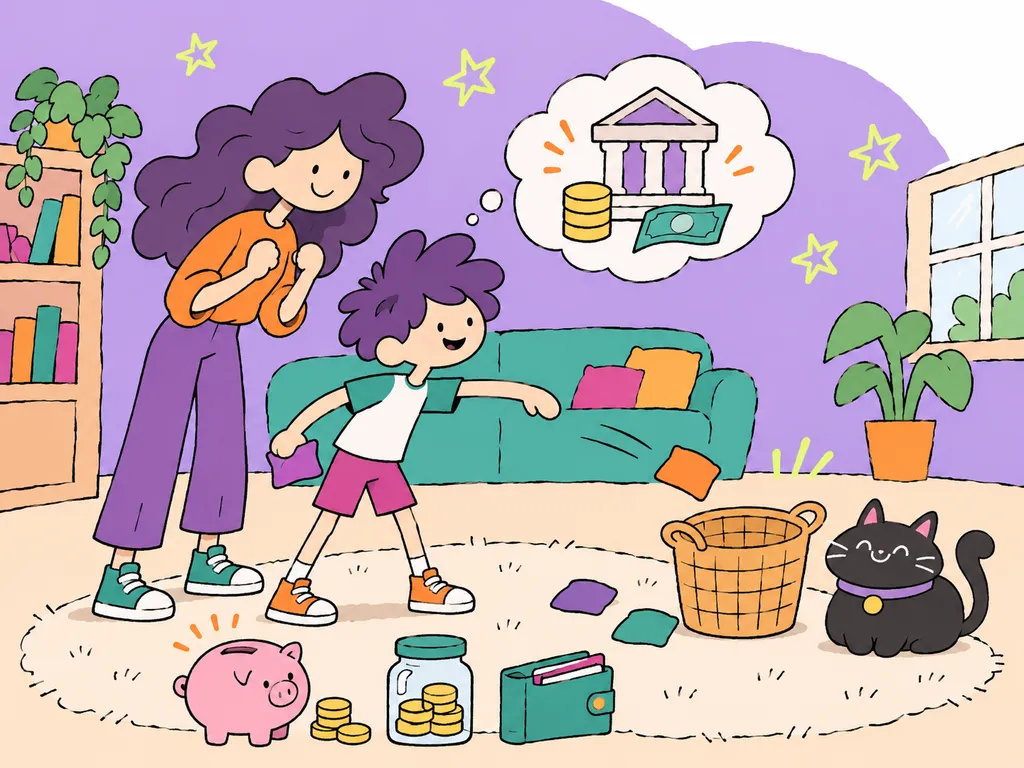
- Role-play a bank visit using coins, a wallet, and two labeled cards.
- Review Banking Vocabulary for Kids: Words and Activities with a four-question family quiz.
When a word has several meanings or pronunciations, Cambridge Dictionary is a useful check before turning it into child-friendly examples.
Frequently Asked Questions
How Many Banking Words Should a Child Learn at Once?
Begin Banking Vocabulary for Kids: Words and Activities with four or five terms per session. Start with concrete words such as coin, cash, card, and receipt before abstract terms such as balance. Review them through sorting, speaking, and role-play. Add words after your child can use the earlier terms in sentences.
What If Our Country Uses Different Banking Terms?
Teach the English variants your child will likely encounter, then mention regional alternatives. Paper currency may be a banknote, note, or bill; a cash machine may be an ATM. Keep your home currency in the activity. Build flexible English without replacing familiar terms or number formats.
Should Children Practise with Real Cards or Account Details?
Never use a real card, PIN, password, or account number. Choose handmade cards, play money, and fictional details. Explain that PINs and passwords stay private and must not appear in conversations, messages, or games. Younger children should ask a trusted adult before entering banking information. Teach safety with the first vocabulary lesson.
How Can Multilingual Children Practise These Words?
Connect English terms with concepts your child knows in other languages. Label a pretend bank in two or three languages, then conduct the role-play in English. Avoid translating every phrase because usage varies across cultures. Pictures, objects, gestures, and brief English definitions build meaning without dependence on one home language.
Follow this three-step plan this week:
- Choose five banking terms and review their meanings.
- Practise them in one five-minute role-play.
- Ask your child to use each term in a complete sentence.
Want to see how these ideas work in a real lesson — try a LearnLink trial lesson.
Stay updated on our latest tips and resources by following us on Instagram LearnLink.